

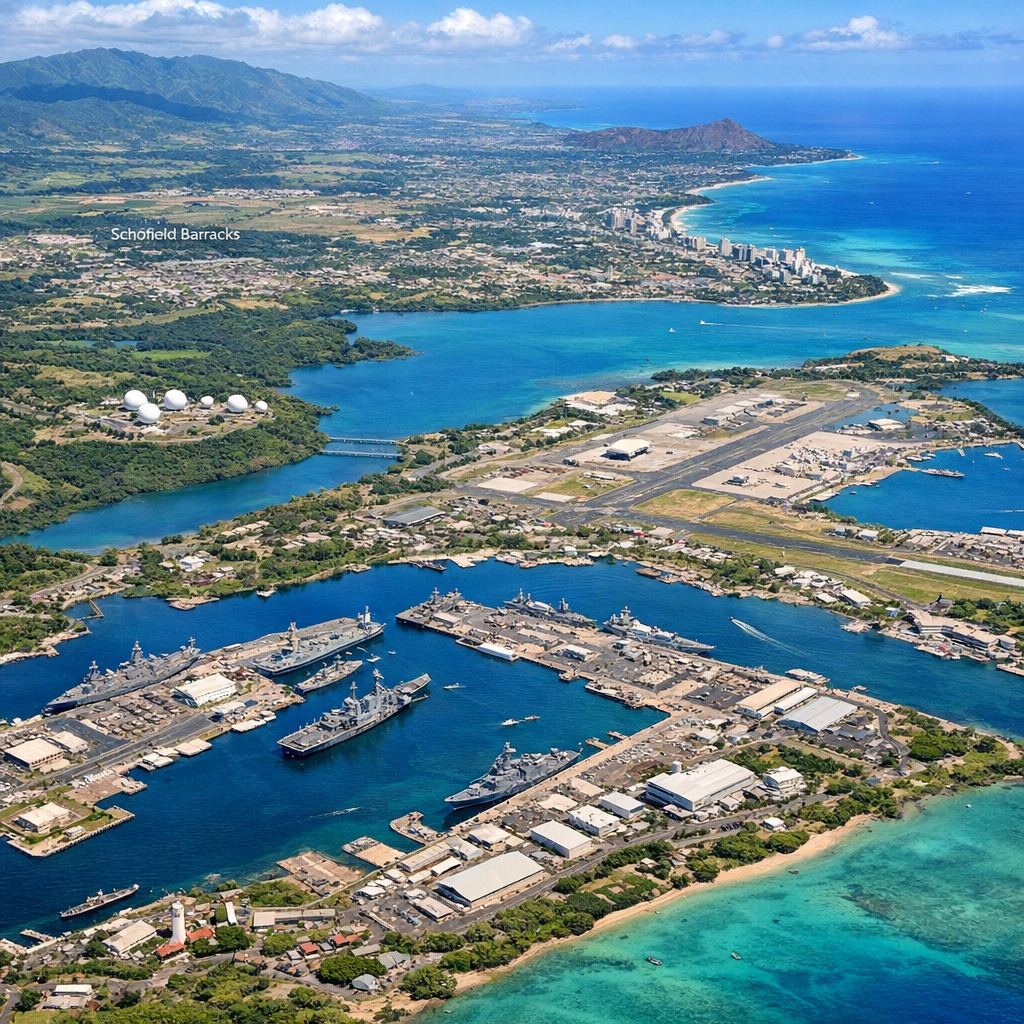
Hawai‘i’s unique position in the central Pacific Ocean has long established it as a cornerstone of U.S. national security. Serving as the headquarters for the U.S. Indo-Pacific Command (USINDOPACOM), Hawai‘i plays a pivotal role in maintaining regional stability and safeguarding national interests.
Central Hub for Military Operations
USINDOPACOM, the oldest and largest U.S. combatant command, is headquartered at Camp H.M. Smith in Hālawa on O‘ahu. This command oversees military operations across the vast Indo-Pacific region, ensuring a free and open Pacific. The presence of all branches of the U.S. armed forces in Hawai‘i underscores its strategic importance. Notably, the state hosts 12 key military installations, including Joint Base Pearl Harbor-Hickam and Schofield Barracks, which support a wide array of defense activities.
Economic Impact and Employment
The military’s presence significantly contributes to Hawai‘i’s economy. Defense spending brings approximately $7.9 billion annually to the state, accounting for 8.3% of Hawai‘i’s GDP. This investment provides over 20,000 civilian jobs and 31,000 contractor positions, highlighting the military’s role as a major employer in the region.
Energy Security Considerations
Ensuring reliable energy infrastructure is crucial for military operations in Hawai‘i. The state’s isolated power grids, managed primarily by Hawaiian Electric Company (HECO), present unique challenges. The military’s substantial energy consumption necessitates a stable and resilient power supply to maintain operational readiness.
Environmental Stewardship
While the military’s presence offers economic and security benefits, it also brings environmental responsibilities. Hawai‘i hosts more federal hazardous waste sites than any other U.S. state, a legacy of extensive military activity. Ongoing efforts aim to address these environmental concerns, balancing defense needs with ecological preservation.
Conclusion
Hawai‘i’s strategic location and robust military infrastructure make it indispensable to U.S. national security. The state’s role extends beyond defense, influencing economic stability and environmental stewardship. As geopolitical dynamics evolve, Hawai‘i’s significance in the Indo-Pacific theater will continue to be a focal point for national defense strategies.