

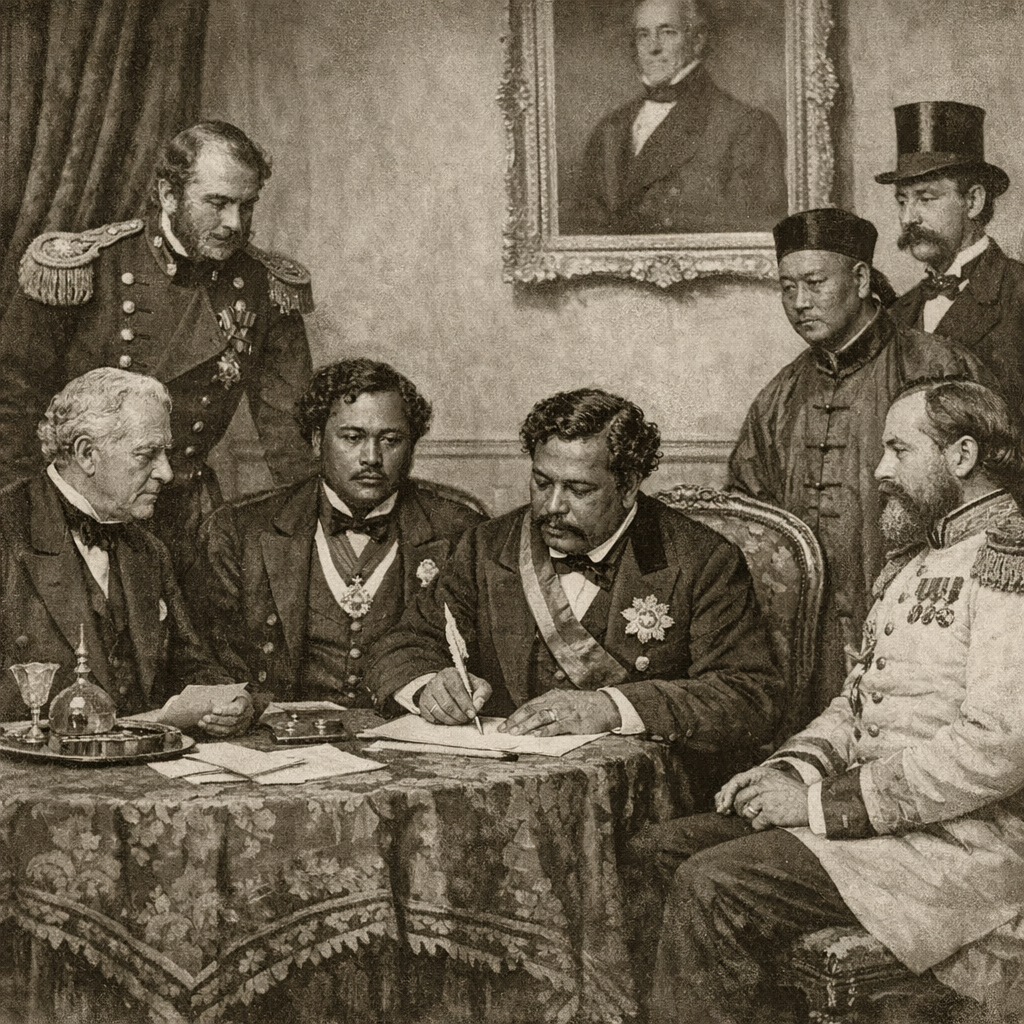
Hawaiʻi’s unique position in the Pacific has long made it a focal point in international relations. From its early days as an independent kingdom to its current status as a U.S. state, Hawaiʻi has played a significant role in global affairs.
Early Diplomatic Endeavors
In the 19th century, the Kingdom of Hawaiʻi actively engaged in diplomacy to assert its sovereignty. Notably, in 1826, the United States signed a treaty with the Kingdom, indirectly recognizing its independence. This was a crucial step in Hawaiʻi’s efforts to establish itself on the world stage. [Source]
Relations with Neighboring Pacific Nations
Hawaiʻi’s interactions weren’t limited to Western powers. The kingdom also fostered relationships with other Pacific nations. For instance, there were diplomatic exchanges and proposed alliances between Hawaiʻi and Tahiti, reflecting the interconnectedness of Polynesian societies. [Source]
Transition to U.S. Statehood
The late 19th century marked a turning point. Following the overthrow of the Hawaiian Kingdom in 1893, Hawaiʻi was annexed by the United States in 1898. This transition significantly altered its role in international relations, aligning it more closely with U.S. foreign policy objectives. [Source]
Modern-Day International Engagement
Today, Hawaiʻi continues to be a hub for international engagement. Institutions like the University of Hawaiʻi at Mānoa offer programs in international relations, preparing students to navigate the complexities of global politics. [Source]
Furthermore, Hawaiʻi hosts various international organizations and events, such as the East-West Center and the Hawaiʻi International Film Festival, fostering cultural exchange and dialogue. [Source]
Understanding Hawaiʻi’s historical and ongoing role in global affairs offers valuable insights into its unique position as a bridge between East and West, tradition and modernity.